 CN
China Suppliers > Wuhan Biet >
CN
China Suppliers > Wuhan Biet > Details for Hydroquinone

| Category: | Organic chemicals and Derivatives |
|
|
| CAS NO: | 123-31-9 | ||
| EC NO: | 204-617-8 | ||
| Molecular Formula: | C6H6O2 | ||
| Molecular Weight: | 110.11244 | ||
| Specification: | 25kg | ||
| InChI: | InChI=1/C9H6O4/c10-6-3-5-1-2-9(12)13-8(5)4-7(6)11/h1-4,10-11H | ||
| Packing: | bag | ||
| Product description: White needle crystals. It is easily soluble in hot water, ethanol and ether, and slightly soluble in benzene. Application: The core applications of hydroquinone can be summarized into three categories: industrial raw materials, pharmaceuticals and cosmetics, and special functions. industrial sector Organic synthesis intermediates: used in the production of dyes, fragrances, resins, etc. Antioxidants: prevent oxidation in rubber, plastic, and gasoline. Photographic developer: a key component of traditional black and white film development. Polymer inhibitor: prevents premature polymerization of unsaturated monomers during storage. Medicine and cosmetics Skin whitening agent: inhibits melanin production and is used to treat pigmentation. Hair dye intermediate: used for synthesizing certain oxidative hair dyes. other purposes Analytical chemistry: used as a reducing agent or color developing agent. Polymer materials: used for synthesizing liquid crystal polymers, engineering plastics, etc. |
|||
| Uses: | Phenols; Analysis of standards; General purpose reagents; Other biochemical reagents; Phenol; Pharmaceutical intermediates; Chemical products - inorganic chemicals; Organic chemical raw materials; Intermediates for organic synthesis - hydroquinone; Chemic | ||
| Synonyms: | 1,4-Benzenediol;Quinol;Hydroxyquinone;1,4-Dihydroxybenzene;benzene-1,4-diol;6,7-dihydroxy-2H-chromen-2-one;1,4-Dihydroxy benzene;1,4-Dihydroxy-benzol | ||
| Molecular Structure: |
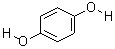 |
||




 Search Product